One of the most common questions patients ask before surgery is, “What will my FUE hair transplant recovery timeline look like?” The truth is that recovery is highly individualized—based on your graft survival, hair caliber, scalp health, and how your body responds to the procedure. Still, there is a predictable pattern most patients follow.
In this week-by-week guide, you’ll learn what typically happens after an FUE hair transplant, what side effects are considered normal, how to care for your scalp during each stage, and exactly when to reach out to FUEsion Hair Clinics if something feels off. Use this as a roadmap—not a rigid schedule—so you can feel confident through the entire journey from day 1 to month 12.
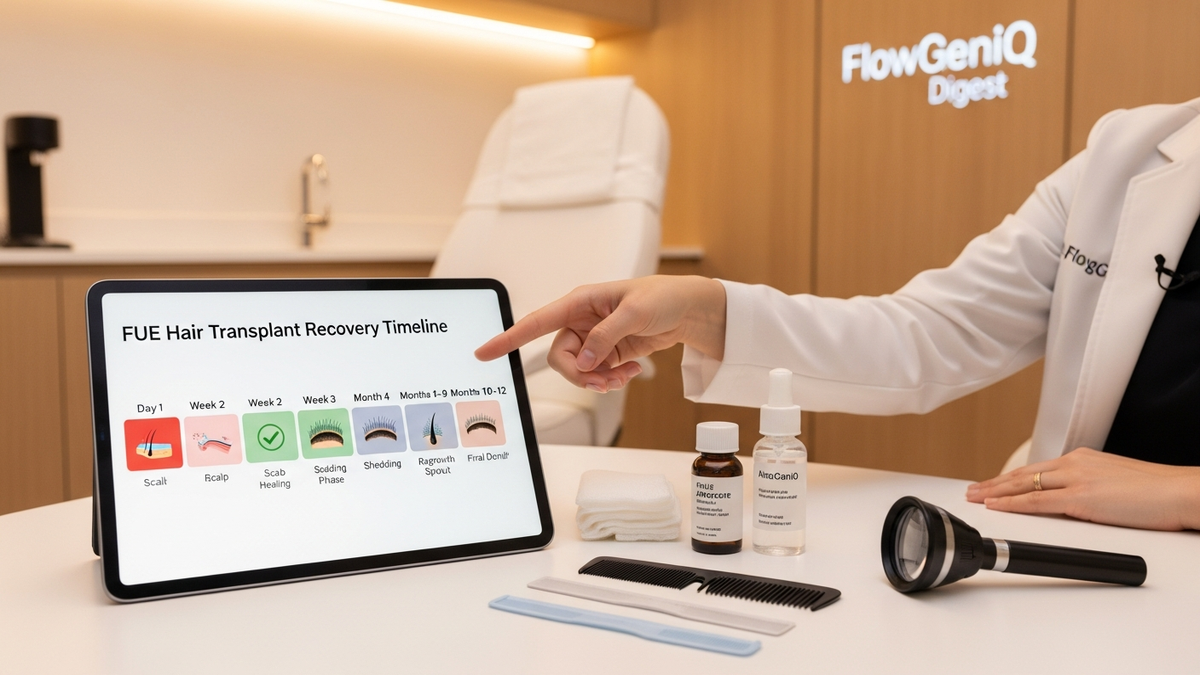
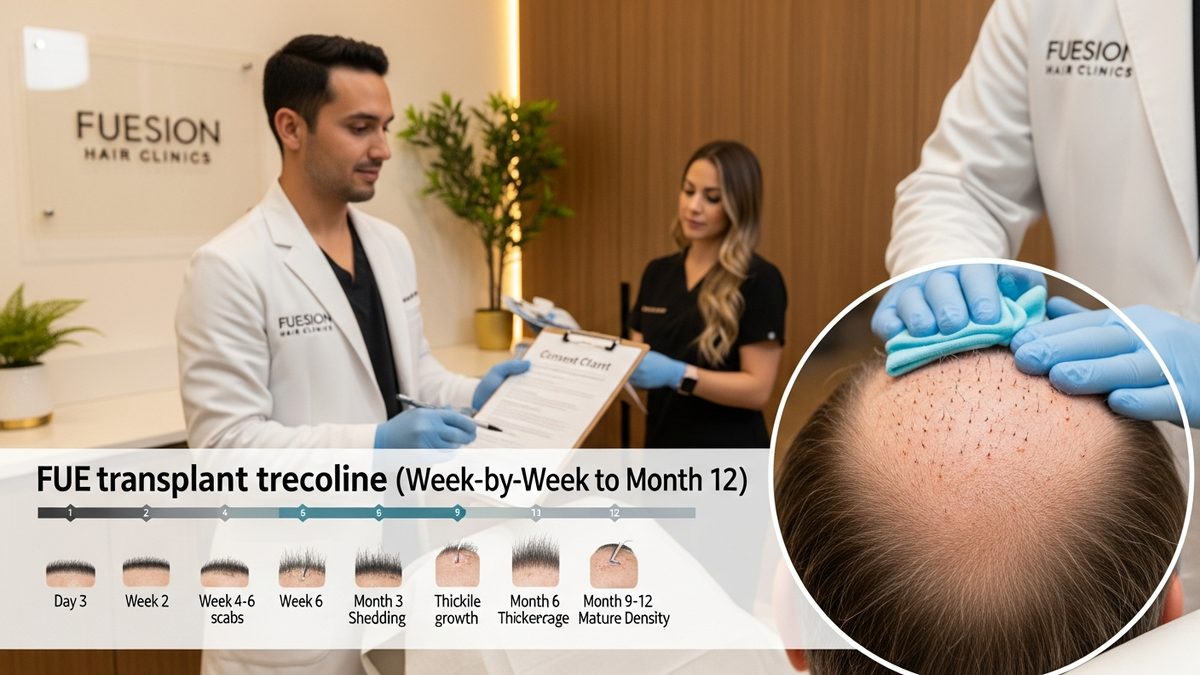
FUE Hair Transplant Recovery Timeline: The Big Picture
Most FUE patients experience four major phases:
- Initial healing (days 1–14): scabbing, redness, tightness, and early shedding.
- Shedding & reset (weeks 2–8/10): transplanted hairs commonly fall out (shock loss).
- Growth phase (months 3–6): new hair emerges and gradually thickens.
- Maturation (months 6–12): density improves and hair texture becomes more natural.
It’s normal to feel impatient during the early months—because the hair you see right after surgery isn’t the hair you’ll keep. Your goal is graft survival first, then gradual regrowth.
Days 1–14: Early Healing & What’s Normal
These first two weeks focus on protecting grafts, minimizing irritation, and allowing the scalp to heal. Your clinic’s post-op instructions matter most during this window.
Day 1 (Surgery Day)
- Typical sensations: scalp tenderness, tightness, mild burning or itching as anesthesia wears off.
- Skin appearance: redness around the recipient area; small punctate dots at donor sites.
- Swelling: may begin later the same day or within 24–48 hours.
- What to do: keep dressings/packing exactly as instructed; avoid touching or scratching; follow medication schedule (pain control and any prescribed anti-inflammatory/antibiotic regimen).
Day 2
- Swelling: often increases, especially around the forehead/eyelids.
- Comfort: tenderness may peak then slowly improve.
- Care focus: gentle hygiene only as directed (some clinics recommend a specific spray or wash method).
Day 3
- Scabbing begins: tiny crusts form around the transplanted grafts.
- Itching: common, but avoid scratching; itching often increases as healing progresses.
Day 4
- Scabs may thicken: this is a normal part of healing.
- Swelling: should begin to settle for many patients.
- What to avoid: direct water pressure, aggressive rubbing, and hair products not approved by your surgeon.
Day 5
- Recipient area: crusts remain; redness still present for some.
- Donor area: may feel tight or tender; tiny scabs at donor sites are expected.
Day 6
- Itching continues: use only recommended soothing measures.
- Hydration & sleep: staying consistent helps your body heal.
Day 7
- Milestone: many patients feel more comfortable at the one-week mark.
- Scab management: some clinics guide gentle removal, while others advise waiting until washing helps loosen scabs naturally.
Day 8
- Scabs loosen: you may notice flaking as healing progresses.
- Hair appearance: transplanted hairs may look “stiff” or uneven—this is normal.
Day 9
- Recipient area: redness should be less intense for many.
- Care focus: stick to your washing schedule; avoid gym sweat and sun exposure unless cleared.
Day 10
- Donor healing: donor scabs often continue to shed.
- Hair shedding may begin: not yet true “shock loss” in all cases, but some hairs can loosen early.
Day 11
- Skin tone: the recipient area can appear more uniform as inflammation calms.
- Common symptom: mild dryness; you may see residual flaking.
Day 12
- Scabs: often significantly improved.
- What to monitor: any unusual pain, spreading redness, or discharge.
Day 13
- Comfort: usually improving.
- Hair texture: transplanted hairs may still be present but can look slightly “seated” in their new direction.
Day 14 (Two Weeks Post-Op)
- Typical healing status: most scabs are gone or nearly gone.
- Skin: may still look pink or slightly sensitive.
- Next phase: the period leading into shock loss begins for many patients.
Weeks 3–8 (and up to 10): Shock Loss & Shedding
One of the most emotionally challenging parts of hair restoration is that the transplanted hairs often shed after the initial healing phase. This is typically called shock loss and does not mean your grafts failed.
Think of it as a reset. The follicle goes through a growth cycle transition before producing new hair.
Week 3
- Shedding may start: hairs loosen and fall out easily.
- Scalp feel: can be less tender; itching usually fades.
Week 4
- Shedding increases: you may see a noticeable reduction in visible transplanted hair.
- Patient reassurance: this is commonly part of the normal timeline.
Week 5
- Recipient area: may look more “bare” than expected.
- Care: continue gentle washing and avoid aggressive styling.
Week 6
- Shedding continues: a large portion of transplanted hairs can fall out.
- Important: do not interpret this phase as permanent loss.
Week 7
- Scalp stability: most patients feel “normal” again day-to-day.
- Growth anticipation: some patients begin to notice early stubble or fine regrowth.
Week 8
- Milestone: many patients have completed the shedding phase.
- Expectations: visible improvement may still be limited—this is normal.
Week 9–10 (Optional Range)
- Early regrowth: fine hairs may start to appear.
- Hair caliber: tends to be thinner at first, then gradually thickens.
Months 3–6: New Growth Emerges
This is where many patients start to feel real progress. While results vary, the general pattern is:
- Months 3–4: early sprouts and visible fine regrowth
- Months 4–6: increased density and thickness
Month 3
- What you may notice: small hairs (“sprouts”) begin to show through.
- Scalp: typically stable with minimal sensitivity.
Month 4
- Density improves: more hairs are visible, and growth becomes more consistent.
- Texture: hair can look finer at first before thickening.
Month 5
- Thickness increase: many patients see a meaningful improvement in coverage.
- Styling: hair may behave more normally as length grows.
Month 6
- Common outcome: noticeable cosmetic change, though full maturation is still ahead.
- Ongoing plan: maintenance therapy may be recommended depending on your pattern of hair loss.
Months 7–12: Maturation, Density, and Natural Appearance
Your FUE hair transplant recovery timeline culminates in a year of maturation. Hair grows in cycles, and the final look depends on graft quality, baseline loss pattern, and adherence to a tailored maintenance plan.
Month 7
- Hair growth: continues; density usually improves gradually.
- Hairline refinement: often becomes more natural as hairs thicken and align.
Month 8
- Coverage: improved—especially in the crown or mid-scalp (if treated).
- Texture: may still be transitioning, but shedding should be minimal now.
Month 9
- Natural look: more blending with existing hair.
- Color match: can improve as pigmentation stabilizes.
Month 10
- Density & thickness: continued gains; some patients notice a “second wave” of improvement.
Month 11
- Finalizing: hair may look fuller and more uniform.
Month 12
- Year milestone: many patients reach their most stable overall result around month 12 (with continued subtle improvements possible beyond).
- Next steps: discuss whether further densification, a second session, or ongoing maintenance is appropriate.
Common Side Effects After FUE (And When to Contact Your Clinic)
Most FUE patients experience mild, temporary side effects. The key is knowing what’s normal versus what requires medical attention.
Common and usually normal
- Redness and swelling: typically peaks within the first 2–3 days and gradually improves.
- Itching: common as scabs form and loosen.
- Numbness or tingling: can occur due to donor/recipient manipulation.
- Crusting/scabbing: part of the healing process.
- Shock loss (shedding): commonly occurs weeks 3–8/10.
- Temporary tightness: especially early on.
When to contact FUEsion Hair Clinics urgently
Call or message your clinic if you notice any of the following:
- Fever or chills
- Increasing pain instead of gradual improvement
- Spreading redness or warmth in the recipient/donor area
- Pus-like discharge or a foul odor
- Severe swelling that worsens after day 3–4
- Persistent intense itching with rash or hives (possible reaction to topical products/medications)
- Significant bleeding that doesn’t stop with gentle pressure as instructed
Because graft survival depends on proper healing, it’s always safer to reach out early if something feels abnormal.
How to Support Your Recovery (Practical, Evidence-Informed Tips)
Your surgeon’s plan is the priority. Below are general best practices commonly used in post-FUE care, which you can align with your personalized instructions from FUEsion Hair Clinics.
Hair washing & scab care
- Follow the exact schedule for rinsing/washing.
- Avoid aggressive rubbing; let the process loosen crusts naturally.
- Use only approved cleansers and avoid harsh scrubs.
Sleep position & physical activity
- Early on, sleep with head elevation as recommended to minimize swelling.
- Avoid heavy exercise and sweating during the first days (timing varies by clinic instructions).
- Return to normal activity gradually—your clinic will guide you based on your healing.
Sun, heat, and hair styling
- Avoid direct sun and extreme heat early on.
- Avoid hair sprays, gels, and styling tools until your clinic clears you.
- Be gentle with hats/caps; pressure can irritate healing grafts.
Maintenance therapy (when appropriate)
Many patients benefit from ongoing medical or device-based hair loss treatment to protect native follicles and support the transplanted grafts. Your plan may include:
- Topical minoxidil (if prescribed)
- Finasteride/dutasteride (if prescribed and appropriate)
- Low-level laser therapy (LLLT) or laser caps
- Microneedling (timing matters—usually after initial healing)
- Anti-inflammatory scalp care
Because medications and devices can interact with your health history, your clinic will tailor recommendations to you.
Personalized Follow-Up at FUEsion Hair Clinics
Recovery doesn’t just happen—it’s monitored. At FUEsion Hair Clinics, follow-up visits typically include progress photos, scalp assessments, and adjustments to your maintenance plan. This is also where we help you interpret the timeline so shedding and early changes don’t cause unnecessary worry.
Many patients are also interested in genetically guided hair health strategies. While a hair transplant addresses existing loss with transplanted follicles, genetic and scalp-health factors can influence how your body responds to maintenance therapies. Your care plan may incorporate a personalized approach to optimize your overall hair health journey.
FUE Hair Transplant Recovery Timeline Summary (Quick Reference)
| Stage | Timeframe | What You’ll Commonly Notice |
|---|---|---|
| Initial healing | Day 1–14 | Redness, swelling, scabs/crusting, itching, donor/recipient tenderness |
| Shock loss | Weeks 2–8/10 | Transplanted hairs loosen and shed; early stubble may be visible |
| Early regrowth | Months 3–4 | Fine sprouts begin; growth becomes more consistent |
| Thickening & density | Months 4–6 | More visible coverage; improved hair caliber |
| Maturation | Months 7–12 | Natural blending, gradual density gains, stable overall result |
FAQ: FUE Hair Transplant Recovery Timeline
1) Is shedding normal in the FUE hair transplant recovery timeline?
Yes. Shedding (often shock loss) is commonly seen during weeks 3–8/10. This typically reflects the hair cycle reset of transplanted follicles—not graft failure. If shedding is accompanied by fever, worsening pain, discharge, or rapidly spreading redness, contact your clinic promptly.
2) When will I see real hair growth after FUE?
Many patients notice early fine regrowth around month 3, with more noticeable thickness and density typically developing between months 4–6. Full maturation is usually assessed around month 12.
3) What side effects should I expect after FUE?
Common effects include redness, swelling, itching, scabbing/crusting, and temporary tightness. It’s also normal for transplanted hairs to fall out during shock loss. Contact FUEsion Hair Clinics if you experience fever, pus-like discharge, severe or worsening pain, or a rapidly worsening scalp condition.
4) How long until I can exercise and sweat again?
Most clinics recommend avoiding strenuous exercise and heavy sweating during the early healing period. The exact timing depends on your procedure and your healing. Follow your post-op instructions, and ask your surgeon for personalized clearance.
5) Can I combine an FUE transplant with other hair restoration treatments?
Often, yes—depending on your goals and medical suitability. Many patients use maintenance approaches such as prescribed medications, scalp treatments, low-level laser therapy, and carefully timed procedures like microneedling. Your clinic can recommend a safe, staged plan to support results.
Ready to Personalize Your Recovery Plan?
If you’re considering or scheduled for FUE, the best way to feel confident about your FUE hair transplant recovery timeline is to review your specific plan with a clinician. At FUEsion Hair Clinics, we’ll discuss your goals, expected milestones, likely side effects, and how we’ll support you from day 1 through month 12.
Next step: Schedule a consultation to review your candidacy and recovery expectations.
Medical Information Disclaimer
This content is provided for general educational purposes only and reflects the clinical experience and protocols followed at FUEsion Hair Clinics. It is not a substitute for professional medical advice, diagnosis, or treatment. Patients are advised to consult a qualified hair restoration specialist for personalized recommendations.